PST! | Practical Singing Techniques for All Ages

Hello All,

If you are reading this post because you attended my presentation called PST! Practical Singing Techniques for All Ages  at the Tennessee Music Educators Association 65th Annual Convention in Nashville, Tennessee, thank you! Here are my presentation slides. I am hopeful the slides that I added—particularly describing my Number Warm-ups (slide 18)—provide even more clarity. Also, I edited several pages to reflect more of what I demonstrated and discussed that was not in the original outline.

I truly enjoyed sharing a few of my teaching methods with all of you. Preparing for the presentation enriched my own teaching and learning, and I am hopeful my thoughts are useful to you as well.

Of course, if you are finding this though you did not attend the presentation, welcome!

Thank you all again, and Happy Practicing!

College Choir Auditions 101

Photo by Brett Jordan on Pexels.com

So, you’re off to college, and you want to keep singing in choir.. 👏 Or, perhaps you are a vocal music major or minor, and singing in choir is a part of your training—but you still have to audition before classes begin. Either way, the question is : How should a singer prepare for a collegiate choral audition? Of course, you may find an explanation of the process on the college website. If not, try to contact the choir director for more information.

Here are a few tips to help you prepare for college choir auditions and beyond!

  1. What excites you about singing in a choir? Be ready for a short chat/interview including why you want to continue singing in choir, how long you been singing in choirs, what instruments you play, etc. They enjoy getting to know the person not just the voice. Even if you are not planning to major or minor in music, write a high school résumé that focuses on music and a repertoire list to make answering these questions even easier. Bring it to the audition. The director may ask you for the document, and you will be ready!
  2. Have a few, short solos you can sing from memory: If you were in choir during high school, you probably learned a few songs you can sing from memory. In general, choose songs that are moderately slow to moderately fast and about two minutes long with a short introduction featuring a well-developed singing range. Also, be sure that there are enough long notes and longer phrases to demonstrate more advanced singing technique. You do not need to sing a really difficult song for a choral audition, either. Good examples include folk songs like Danny Boy, Shenandoah, or the melody of a song you sang in choir instead of the harmony. Just be sure that you own a clear PDF and/or printed sheet music plus the piano track. Usually the director or pianist will play with you for a live audition, so they will need the PDF. When you have the track, you can practice well, and you may need it for the audition!
  3. Be ready to vocalize in the audition: Though not every audition will include vocal warm-ups, if you expect it, then you won’t be caught by surprise! Warm-ups give the director a chance to listen to your tone quality and test your singing range. Plus, they like observing your technique when singing music you did not prepare for the audition.
  4. Pitch matching, too!: Besides a few warm-ups, some auditions feature a pitch matching component, so singers can demonstrate basic aural skills. Typically, the director will play a series of three to five pitches—though three is more likely—for you to repeat a cappella on a neutral syllable like [da] or [lu]. Again, this is a wonderful opportunity for the director to hear you sing music you did not prepare, watch your singing technique, and listen for good intonation and healthy tone quality. In general, singing three to five notes in a row accurately and in tune with no more than three times to hear the pattern is an excellent goal for any singer.
  5. And now…sight singing!: For many high school singers, this is the most anxiety inducing part of an audition. Be ready to demonstrate your skills in two ways: 1) 30-second practice of eight measures, then sing again for the “final reading;” 2) A short SATB song with the director playing all the parts simultaneously while you sing the part you usually sing in choir. For example, if you usually sing soprano, you may be asked to sing the selection twice to demonstrate both the soprano and alto parts.

Finally, below is a list of what several of my students have had to sing for a college choral audition. Your audition may include a few of these elements, though rarely all because time is limited!:

  • Classical solo or art song in English or a foreign language
  • Excerpt of a choral work assigned 3-6 weeks before the audition
  • Excerpt of choral work from previous choral experience
  • “America” (My Country ‘Tis of Thee) in several keys a cappella or accompanied
  • Pre-1970 and/or post 1970 music theatre selection
  • Singing range exercises (possibly Soprano/Alto: E3 – E6; Tenor/Bass: E2 – E5)
  • Pitch Matching/Echo – examples played or sung up to three times before repeating using a neutral syllable
  • Rhythm Matching/Echo – examples tapped, clapped, or spoken up to three times before repeating
  • Eight-measure and/or harmonic sight singing

Try to think of what you would add if you were a choir director, too. TOI, TOI, TOI!!

And Now . . . Sight Singing!

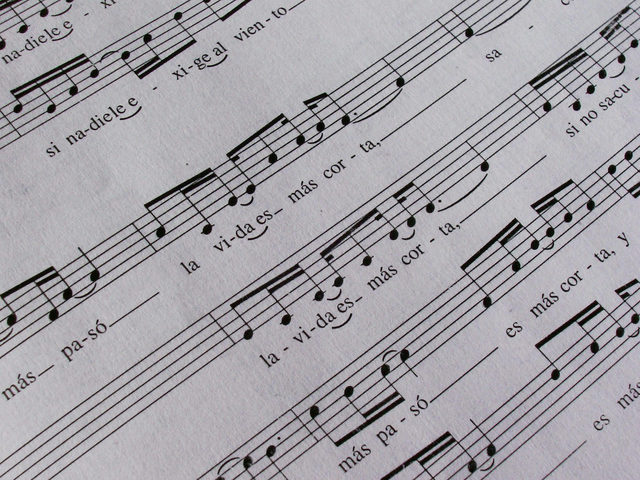
Sheet Music

Free Images

By this time in the school year, you know the procedure for the sight singing audition very well:

  1. The tonic triad will be played in broken (arpeggiated) style which you will sing out loud using solfeggio syllables as it plays.
  2. You will have 30 seconds to practice singing an eight measure example.
  3. After 30 seconds, the tonic triad will be played again.
  4. You will count-in at a slow to moderately slow tempo before singing your final reading.

However, what is easy to describe is not necessarily easy to demonstrate. Here are a few general tips to help you feel more confident for the sight singing version of your audition:

  • Drill Your Key Signatures: Most often, the example begins on the tonic pitch (“Do”). However, practice identifying your key signatures a lot, so you’re not confused by a tricky one—especially if it doesn’t start on the tonic.
  • Practice Daily: For most, sight singing improves more consistently over a series of weeks rather than a few days before the audition. Try practicing one or two letter names a day. For example, Monday could be A-flat/A major and B-flat/B major; Tuesday: C/C-sharp major (though C-sharp is highly unlikely) and D-flat/D major (D-flat is less likely than D), etc. Inevitably, you will have some key signatures that are very easy for you, so you will need to spend more time with the harder ones.
  • Record Yourself: Audio record your practice and your final reading. When you listen to the track, judge yourself for correct rhythms and pitches. Are you singing at a consistent tempo? How is your intonation? Are you missing certain intervals or rhythm patterns regularly? Are you stopping too often?
  • Record Yourself singing with the Answer Track: Most of you are using a computer program to practice sight singing. Record yourself singing with the answer track after you independent, final reading. Compare that recording to your previous, “final reading” recording. What improved? What can you improve easily the next time you practice?
  • Record yourself without the Answer Track Again: Yes, one more time for the same example! Was the tempo for the final reading appropriate? Were you able to improve any pitches or rhythms you may have missed before? Were you able to keep singing even if you missed a pitch or a rhythm? Did you recover quickly when you made a mistake?

These tips should help you become more comfortable with the procedure and improve intervals and rhythm patterns that are frequently used in sight singing examples. Try to notice the same musical ideas used in your repertoire to inform your sight singing, too.

Finally, if you are really uncertain, remember this: Songs are composed of short and long notes that go up, down, or repeat in a stepping or skipping fashion:

  1. If you are not sure what to sing next, sing a neutral syllable and focus on the direction of the pitches while demonstrating shorter vs. longer notes.
  2. Don’t forget to look ahead at least one note at a time as you sing.
  3. Keep your eyes moving forward past bar lines and the end of the staff, too.

Again, even if you think you might miss the next note, focus on the rhythm, and try to sing in the correct direction—try not to sing higher if the next note is lower, etc. If you can do that, at the very least, we’ll know that you understand how the sound-graph we call music works!

YOU CAN DO IT! 😎

Updated: June 10, 2025

Now . . . Set the Stage to Practice Singing.

Auditorium – Pexels

Pexels/Pixabay

You’re rested, you’re hydrated, and you’re ready to practice, but is your space ready for you? When choosing a space to practice singing, consider the audition or performance experience. Will you be in a classroom, a choir room, or a theatre room with a small stage? During my undergraduate years, my favorite practice space was a small recital hall because it was spacious and uncluttered—just a piano, my music, a music stand, my supplies, my portable tape recorder and my “boom box!”

Assuming you can’t afford to build a personal recital hall in your home, you only need a few adjustments to turn any space into a good “practice room.” For example, here are seven tips for how to set the stage to practice for all-state auditions:

Continue reading